English Lit 101 by Brian Boone
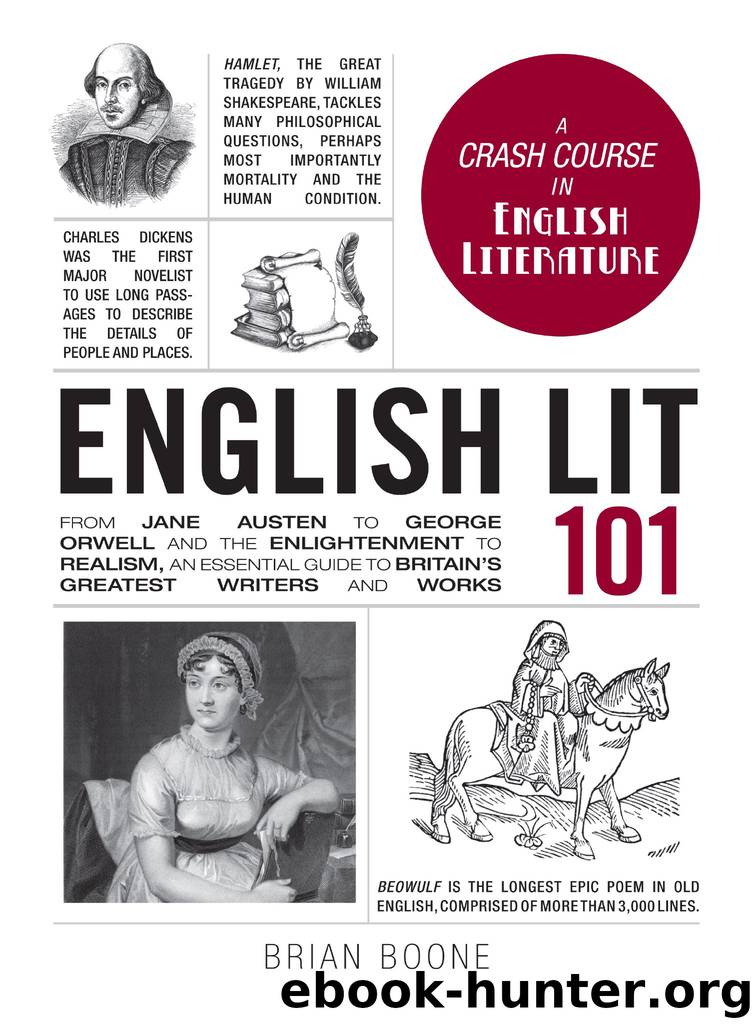
Author:Brian Boone
Language: eng
Format: epub, mobi
Publisher: Adams Media
Published: 2017-01-01T05:00:00+00:00
Alfred, Lord Tennyson
It’s Good to Be the King
Alfred Tennyson was born in the idyllic village of Somersby in August 1809. Like a kid in the twentieth century who saw Star Wars and went out to his backyard with a branch and pretended he was Luke Skywalker with a lightsaber, Tennyson got hooked on the canon of King Arthur legends, which his poetry-loving mother frequently read aloud, and he spent his childhood playing near a stream, pretending he was King Arthur or Sir Lancelot. Those stories, and that literary tradition, would propel Tennyson to an illustrious literary career.
Tennyson’s father was mentally ill, epileptic, and an alcoholic, who in spite of all that was a Cambridge-educated minister who ran the Somersby rectory. He insisted that Tennyson only read the classics and pursue a more suitable career, such as the ministry, but Tennyson’s mother encouraged him to write his own epic tales. Under her tutelage, he memorized large swaths of Le Morte d’Arthur and John Milton’s Paradise Lost. By the time he was fourteen, he had written his own Arthurian heroic tales of knights, as well as a 6,000-line epic poem and a play in blank verse called The Devil and the Lady. At eighteen, he went to Cambridge and, with his brother Charles, published Poems by Two Brothers. It wasn’t a literary sensation, but it did get him the attention of an underground literary club at the university, which was led by a fellow student named Arthur Hallam. Hallam and Tennyson became close, but Hallam died of a brain hemorrhage in 1833, just six years later. Many of Tennyson’s poems were in tribute to Hallam, and Tennyson’s son, who would become one of the most important Tennyson scholars, was named Hallam Tennyson. Tennyson credited Arthur Hallam with giving him not only the confidence to write, and to write what he wanted—about King Arthur, and almost only about King Arthur—but also to perform his poems aloud.
Alfred, Lord Tennyson’s most striking contribution to the history of England is inspiring a nationalistic fervor and a pride in the country’s art. He did it by stoking a revival in the King Arthur and the Knights of the Round Table legends. And that was precisely Tennyson’s intent. To him, the King Arthur stories were a major part of the English heritage that contemporary readers ought to embrace because their themes were so relevant to his time period. He called these legends “the greatest of all poetical subjects” because they were about such universal themes as honor and chivalry, and provided realistic character archetypes.
Download
This site does not store any files on its server. We only index and link to content provided by other sites. Please contact the content providers to delete copyright contents if any and email us, we'll remove relevant links or contents immediately.
4 3 2 1: A Novel by Paul Auster(12392)
The handmaid's tale by Margaret Atwood(7763)
Giovanni's Room by James Baldwin(7346)
Asking the Right Questions: A Guide to Critical Thinking by M. Neil Browne & Stuart M. Keeley(5775)
Big Magic: Creative Living Beyond Fear by Elizabeth Gilbert(5771)
Ego Is the Enemy by Ryan Holiday(5448)
The Body: A Guide for Occupants by Bill Bryson(5096)
On Writing A Memoir of the Craft by Stephen King(4944)
Ken Follett - World without end by Ken Follett(4732)
Adulting by Kelly Williams Brown(4574)
Bluets by Maggie Nelson(4556)
Eat That Frog! by Brian Tracy(4540)
Guilty Pleasures by Laurell K Hamilton(4449)
The Poetry of Pablo Neruda by Pablo Neruda(4107)
Alive: The Story of the Andes Survivors by Piers Paul Read(4033)
White Noise - A Novel by Don DeLillo(4010)
Fingerprints of the Gods by Graham Hancock(4004)
The Book of Joy by Dalai Lama(3986)
The Bookshop by Penelope Fitzgerald(3853)
